





Koojan is bold by day. But as night falls and shadows grow, that brave little girl won’t step out of her room. No tantrums, no tears; just a quiet refusal. What is this fear? Where did it come from? It’s hard to say.

Fear is natural. Some kids are like lions, others like rabbits. And that’s okay; our children don’t need to roar. But they shouldn’t always run either.

Most fear begins in the unknown. A dangerous road in your hometown may feel safer than a quiet lane in an unfamiliar city. A new kitten in your home will tiptoe in fear on the first day, but by next week, it’s sprinting across the living room. Familiarity is the cure.

That’s the secret: turn the unknown into the known. Even a kind old man with a snowy beard may frighten a toddler at first glance. But once he becomes “ours,” that same child tugs his beard and sings rhymes on his lap.

So what about the dark? That’s the unknown in Koojan’s world. The question is, how do we make it familiar? The answer: through play.
This is where the “game of light and shadow” begins. Start simple. Play hide-and-seek. First round: full light. Dad hides. Koojan finds him. Then it’s her turn to hide. Next, dim the light. Maybe a 25-watt bulb. Then a lantern. Then a candle. And finally; a torch in Koojan’s hand. “Go on now. Let’s see if you can find Papa!”

In the thrill of the game, Koojan forgets her fear. She’s seen the room by daylight a hundred times. Now it’s the same space, just softer, quieter. She ventures out. And finds him. He lifts her in a big warm hug. They laugh. Share a treat. The scent of fear dissolves into bedtime talk.
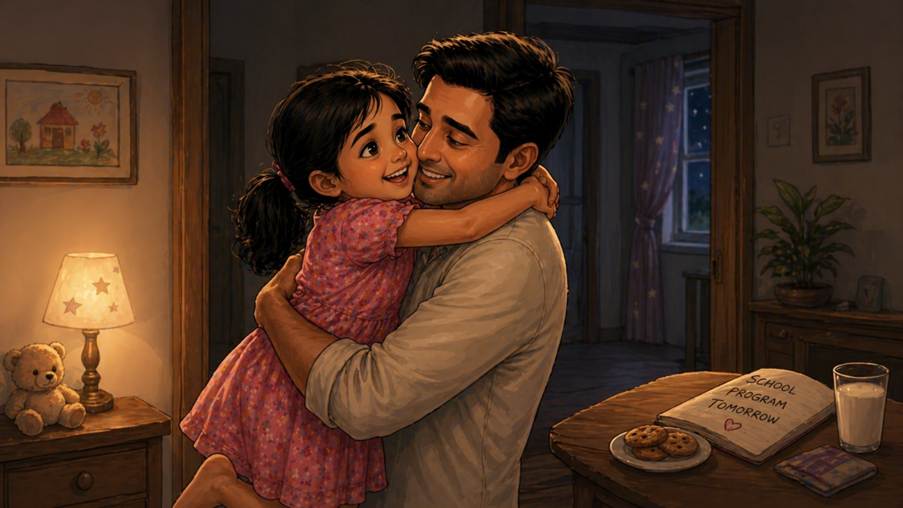
“Beta, there’s a school program tomorrow, isn’t there? Which frock will you wear?”
That’s how a child meets darkness for the first time; with joy instead of dread.
Later, move the game. From the room to the bathroom. Then the garden. Let the adventure grow as they grow.
Here’s another trick; and it works. Arun tells a story from childhood. He used to feel nervous. Fluttery. On edge. He never told anyone. Then one day, a family visitor took his palm and said, “Wow! If he’s a boy, he’s brave. He won’t fear anything. Not even death.”

Arun still remembers the pride he felt that day.
That evening, a window upstairs slammed shut. Grandma called out, “Arun, go close it.”
His heart trembled. Upstairs was dark. But then; those words echoed in his mind. Brave. Fearless. “I’ve got a moustache and beard, don’t I? I’m not scared of the dark!” he told himself.
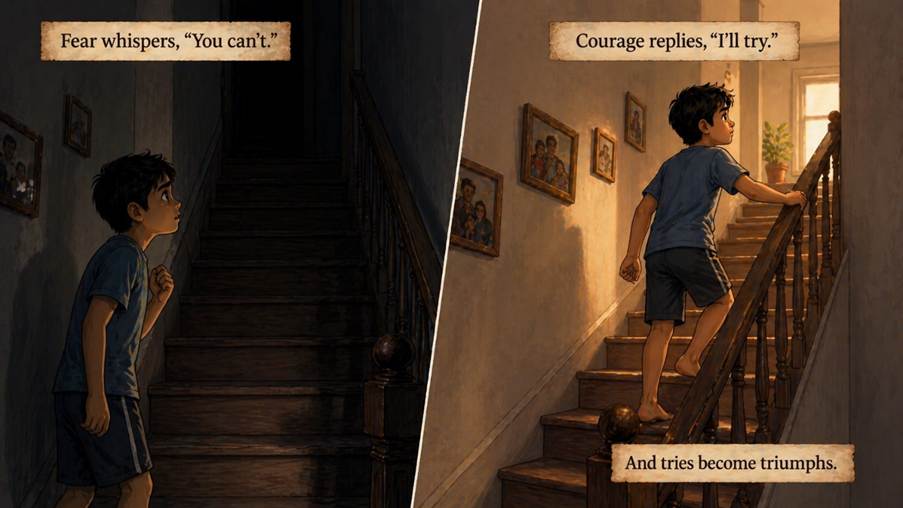
He raced up the stairs. Shut the window. Stood there grinning. That moment changed him. Fear flew out through that very window; and never came back.
Want another method? Here’s one we tried in Vadodara. Our little Ami, just five, was afraid to get in a boat at Ajwa Lake. We all got in, and her eyes filled with tears.
Without saying much, her father pulled out a handkerchief. “Let’s do something special today,” he said.
He turned to one person. “Are you scared?”
“Yes, a little,” came the reply.
“Put your fear in this handkerchief,” he said, pretending to gather it.
Then another. And another. Each person, big and small, made a show of putting fear into the cloth.
Finally, he turned to Ami. “You’re a little scared too, aren’t you? Let’s put your fear in here too.”
He gathered it up. Twisted the handkerchief tight. And dropped it in the water.
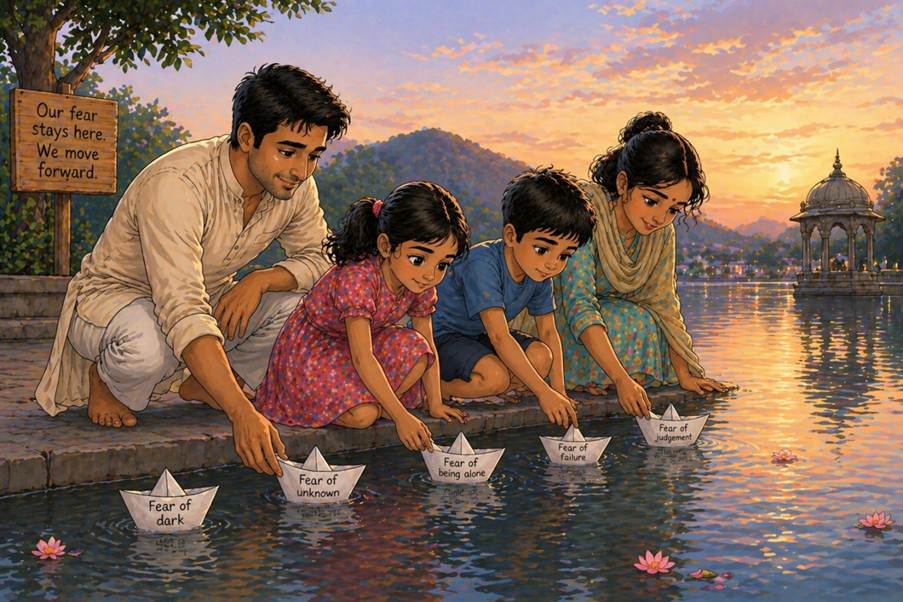
Together, we all said: “Our fear has sunk. It’s gone. Sunk in the lake!”
Gijubhai once helped children jump from a high ledge. When one child hesitated, he spread a handkerchief on the ground. “Still afraid? Look; I’ve made a soft bed for you.” The child leapt.
Children don’t need lectures. They need small experiences. A gentle push. A touch of love. Fear will melt.

Which method works for which child? No one knows. But if there’s one rule: let the child feel surrounded by courage and love. Let them feel, “I’m not less because I’m scared. Everyone feels fear. But I’m learning how to let it go.”
Every day, give your child a tiny introduction to something unfamiliar. Let them meet the big banyan with prayer flags. Let them touch a smooth snake stone at the temple. Show them the night sky. Not to frighten them; but to help them grow.

Lord Krishna named Abhaya; fearlessness; as the first virtue in the Gita. Let’s plant that seed early. It won’t grow on its own. Parents must become skilled farmers. Sow it. Nurture it. Guide it with care.
Children don’t just “grow.” They’re raised.
One last story. During World War II, as bombs rained over London, British leader Sir John Strachey wanted to bring his kids back from America. A journalist asked, “Why now? Everyone is sending their children away.”

Strachey replied, “Because I want my children to witness the courage of our people. I don’t want them to miss this moment.”
That’s what true parenting looks like.