




Adapting Children to the Changing Lifestyle
The lifestyle is changing rapidly. Changing economic factors and increasing individual needs influenced by mass media like TV appear to be responsible. Many changes are irreversible, and hence adapting to them becomes necessary. It is not wise to indulge in the ostrich-like mindset that “it will all settle in time.”

The questions that once troubled only urban people have now become universal. Even the lifestyle of people living in villages has changed in such a way that there’s hardly any difference between urban and rural problems.
People have to move like the hands of a clock. One must follow the timings of buses and trains, as well as offices and factories. There’s a constant sense of insecurity, fear, and ever-increasing vehicular traffic. Economic pressure, increased thefts, robberies, professional instability, diseases caused by polluted air, water, and soil, and mental stress due to the need to adapt to new methods and technologies in employment; these issues drain people’s energy all day long, starting from the time they wake up until they go to bed, and perhaps even in dreams.
If the alarm doesn’t ring, they won’t wake up on time. Missing the bus or train becomes likely. If the scooter breaks down, there’s fear of getting late. Shortage of electricity, water, or cooking gas causes trouble. There are burdens of paying off loans taken for showy luxuries, ongoing demands from children’s schools; such countless problems keep arising.
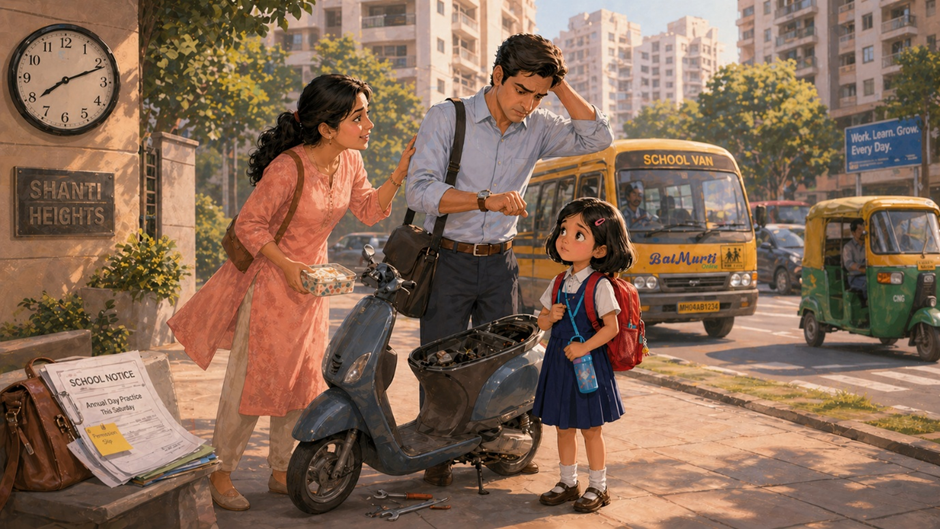
Due to changing circumstances, children also face new problems. Instead of playing freely by choice, they must wake up at a fixed time from as early as two to two-and-a-half years of age, get ready according to a set routine, engage in (what many consider) mostly meaningless studies, wear uniforms, complete homework, keep track of rickshaw timings, and give exams; so many things become compulsory for them.

To understand what children think about different problems, an experiment was conducted. Kindergarten children were presented with a few problems and asked how they would solve them. The aim was to observe the children’s problem-solving thinking.
Problems:
- When you reach home, the door is locked.
- While walking to school, your slipper breaks.
- It’s time to go to school, and your mother forgot to prepare your snack.
- Your mother is not at home, and no one else is. You need to do your homework, but the notebook and pencil are kept out of your reach.
- On the way to school, you realize you’ve forgotten your water bottle.
The children gave a variety of interesting answers.
For example, for the first problem, these were some of their responses:
- I’ll ask the neighbor for the key if mom left it there.
- I’ll take a nail and break the lock.
- I’ll sit outside and wait for mom.
- I’ll cry.
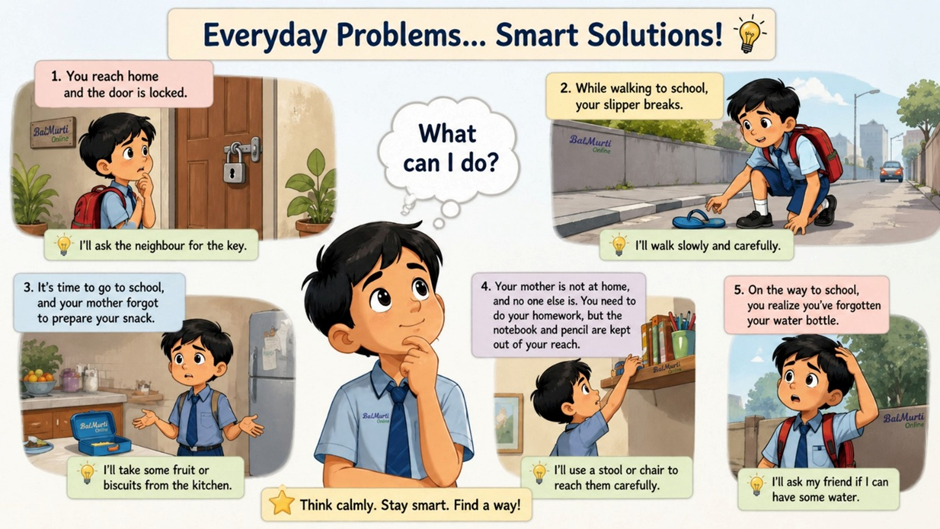
To cultivate the ability to take proper action in unexpected situations, children must be trained in problem-solving. To adjust easily in a changing lifestyle; to adapt to it; it seems wise to begin guiding children from an early age. Furthermore, adults should also become role models in this regard.
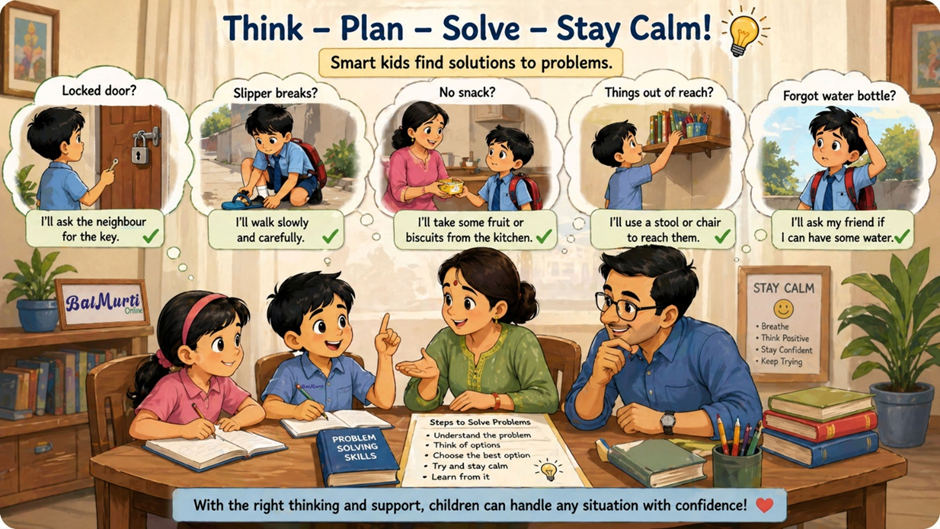
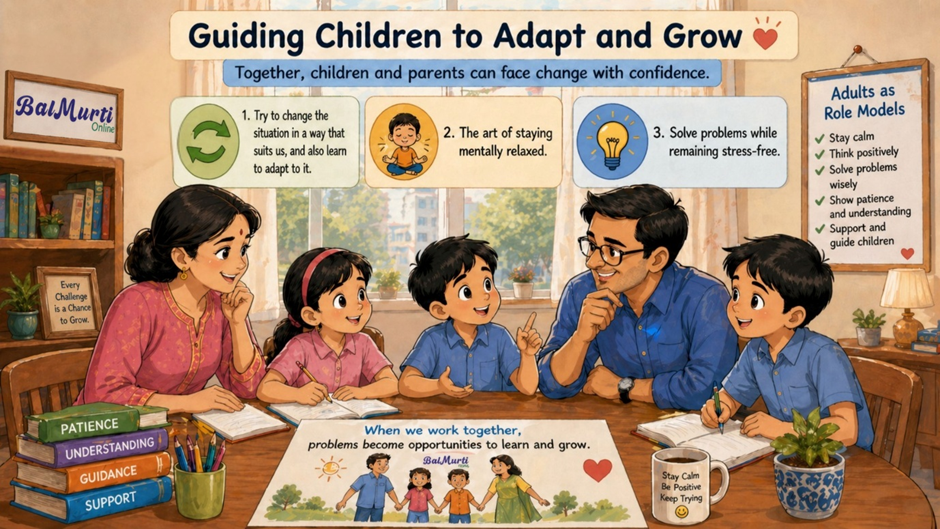
Here are some important points to emphasize in guiding children:
- Along with trying to change the situation in a way that suits us, it is also necessary to attempt to successfully adapt to the situation.
- The art of staying mentally relaxed.
- Solving problems while remaining stress-free.
Children are always influenced by the behavior of adults. If a survey is conducted on how parents respond to problems, that could also prove useful, and arrangements could be made so that both children and parents receive guidance.
If someone conducts research or experiments based on the problems presented to the children in this article; or similar problems; and shares the results, we would be grateful.