
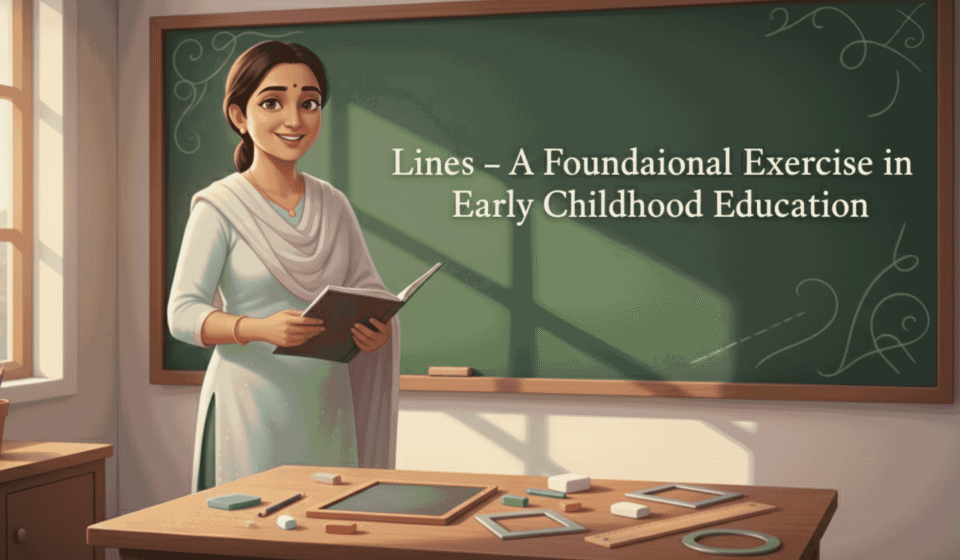

In the realm of early childhood education, one of the foundational practices to develop handwriting and drawing skills is the art of line drawing; known as “Lintaa Kadhavvu” in Gujarati. The core purpose behind encouraging children to draw lines is to bring stability and freedom to their hand movements, which is essential for both alphabet formation and early art expression. When a child can confidently draw long and short lines with controlled ease, we can say their pencil grip has achieved stability and flow.
Table Of Content
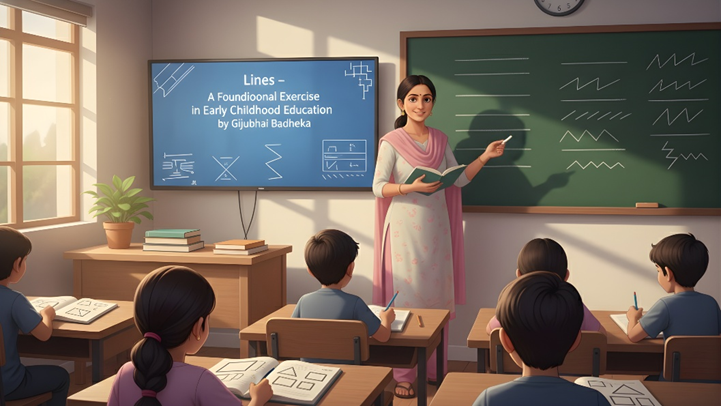
Understanding Line Drawing in Primary School Classrooms
In primary classrooms, children can be broadly categorized into two groups when it comes to line drawing (or tracing lines as a fine motor skill). The first group consists of children who already have pencil control and can complete line exercises quickly and with accuracy. However, due to this speed, their strokes may seem forceful, as if they’re shading rather than tracing.
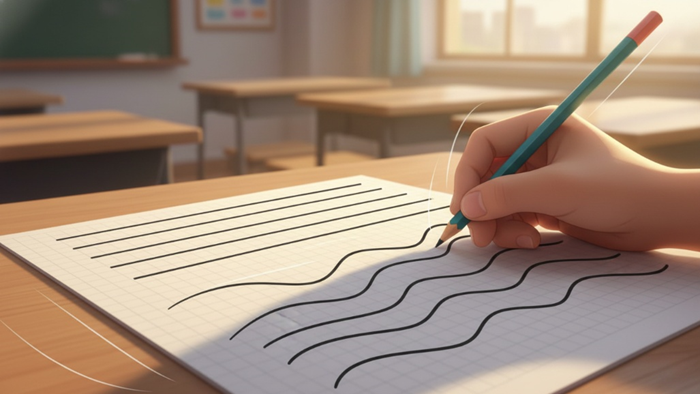
The second group contains children who lack pencil control and end up pressing and rubbing their pencil heavily to fill colors or draw lines. Their strokes lack uniformity in direction and intensity. A closer look at their drawings reveals an uneven spread of color and form, unlike the smooth, consistent wash-like coloring done by children with better grip and control.
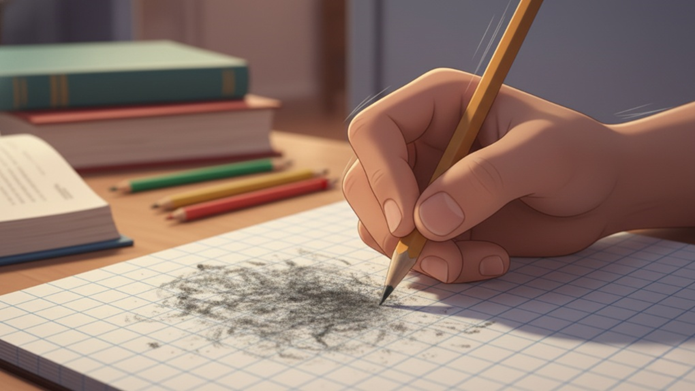
This difference in technique is crucial. Often, younger children mimic older peers or adults, attempting to replicate finished drawings without understanding the stages of skill development that precede mastery. They only see the outcome but remain unaware of the repetitions and exercises that led to such proficiency. As educators and parents, it becomes our responsibility to steer children away from poor imitation; to discourage them from rubbing or shading lines and instead encourage free and controlled movement.
Teaching Line Drawing the Right Way
The correct pedagogy for line drawing involves starting with careful guidance. If a child has already picked up incorrect habits, it is vital to repeatedly demonstrate the proper method. Do not draw lines too close together when demonstrating; leave space between lines to emphasize freedom of movement. At times, you may also demonstrate that drawing closely spaced lines can still result in beautiful patterns; but never through rubbing or shading.
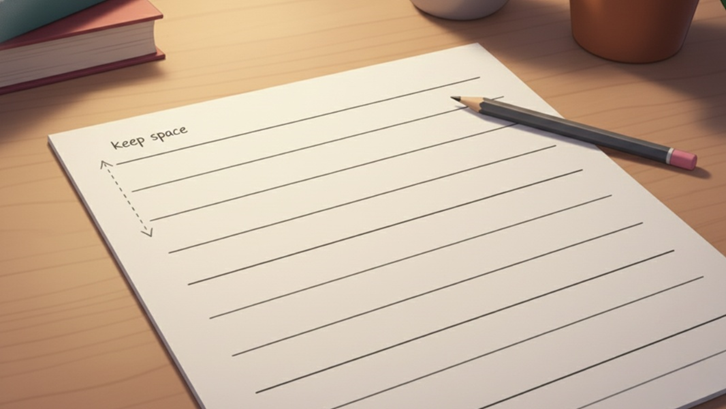
Keep examples of completed line patterns on the first page of the child’s notebook, or display them prominently in the classroom. This helps children realign with proper technique if they deviate. The ultimate goal is to let the child experience the joy of drawing free-flowing lines (zigzag, curved, straight) naturally; not slowly, and certainly not rigidly.
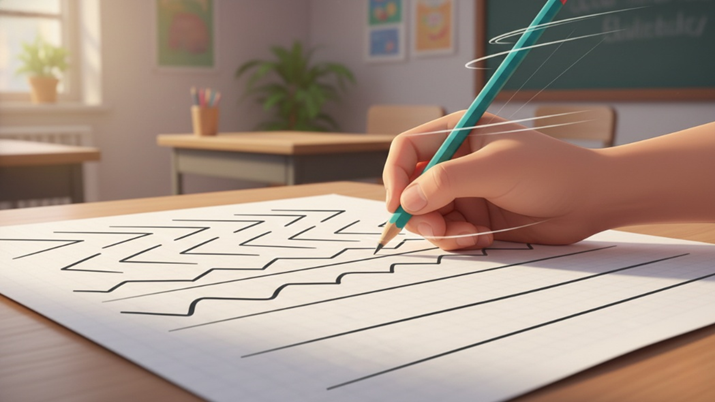
Children should develop the ability to stop their strokes at the right boundary even while drawing quickly. This builds both control and discipline. The process of joining predetermined points through lines; in straight, angular, or geometric ways; naturally develops spatial intelligence and hand-eye coordination.
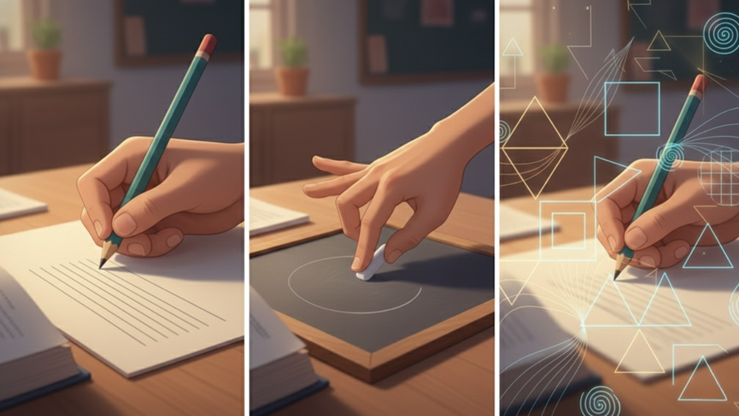
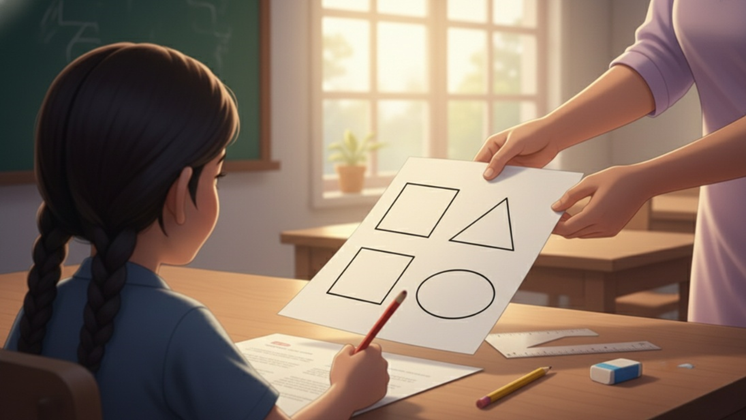
Geometric shapes offer an excellent foundation for this. When a child draws a line between two given points, they’re not just improving motor skills but also unknowingly developing geometric thinking. As their lines become straighter and more parallel, they subconsciously learn to connect opposite points. Initially, the joy is simply in drawing. Gradually, as the boundaries of the shape become apparent, and the child aims to keep the lines within limits, real hand coordination begins; and with it, a deeper sense of satisfaction.
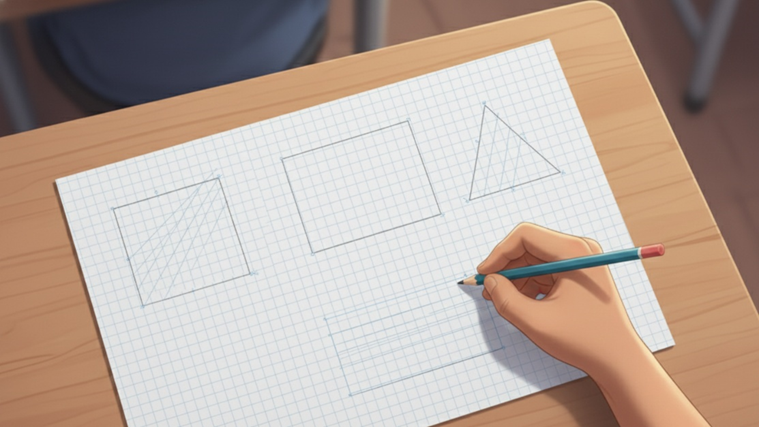
Even if mistakes occur, there is no overwhelming pressure. The beauty of this method is that even invisible endpoints are joined intuitively; this is the secret to learning through geometric forms.
Older students who haven’t practiced line drawing may try to do it using measured calculations; but this is a false sense of mastery. Such children need correction and redirection toward the appropriate method.
Practical Applications in Primary Education

Incorporating line drawing exercises in all lower primary school levels can yield immense developmental benefits. The resources needed are minimal: ten geometric templates, slates (or small blackboards), and chalk stones (kankars). If the shapes are made of iron, they will last for years. Affluent schools can provide paper and colored pencils to make the activity more enjoyable, but even with limited resources, significant learning outcomes can be achieved.
Key Benefits of Line Drawing Activities:
- Improves pencil grip and hand control
- Enhances finger dexterity and flexibility
- Introduces children to geometric shapes and visual patterning
These structured exercises serve as a prelude to both handwriting and drawing skills. In terms of education development, line drawing is not merely an art activity; it’s a foundational motor skill crucial for fine motor development, cognitive structuring, and even early geometry education.
Disclaimer: This article reflects the author’s personal insights and reflections. It is shared with the intention of encouraging thoughtful parenting and generational harmony. The project and foundation are acknowledged as part of the original source for transparency and integrity.